The True Cost of a Fragmented Tech Stack

The average recruitment agency uses five to seven separate software tools to run their daily operations: a standalone ATS, a CRM for business development, a sequencing tool for outreach, a background check portal, and accounting software for invoicing. This fragmentation is a hidden tax that is bleeding your margins dry.
Key Takeaways
- The Context Switching Tax: Recruiters lose up to 1.5 hours daily just moving data between disconnected tools.
- Compliance Nightmares: Managing GDPR/CCPA requests across multiple decentralized databases is a massive legal liability.
- The Unified Solution: Consolidating onto a single platform (like Salesforce) reclaims thousands of hours and guarantees data integrity.
The Productivity Sinkhole
Every time a recruiter switches from their ATS to their email, and then to their CRM to log a note, cognitive friction occurs. This is known as "context switching." While it seems minor in the moment, it compounds massively at scale.
Our recent time-motion study of mid-market staffing firms found that consultants lose an average of 1.5 hours per day simply copying, pasting, and reconciling data between systems. In an agency with 50 recruiters, that equates to 18,000 lost hours per year.
"A fragmented tech stack isn't just an annoyance for recruiters — it's a financial liability for agency owners. Disjointed systems quietly erode placement margins."
Data Silos and the Illusion of APIs
Software vendors often claim their tools "integrate seamlessly." However, relying on APIs to bridge five different platforms is a recipe for disaster. APIs break, rate limits are exceeded, and data mappings change. The result is a fractured database where the ATS says a candidate is "Active" but the CRM shows the associated client account is "On Hold."
1. The API Limit Problem
When APIs fail or hit rate limits, data sync stops, causing recruiters to double-dial clients.
2. The Reporting Nightmare
Cross-platform reporting requires manual CSV exports, VLOOKUPs, and days of processing.
Fragmented Stack vs Unified Platform
| Category | Fragmented Stack (5+ Tools) | Unified Salesforce Platform |
|---|---|---|
| Data Location | Scattered across 5 databases | Single source of truth |
| Compliance (GDPR) | Must manually delete in 5 places | One-click centralized deletion |
| Recruiter Time Wasted | 1.5 hours per day | 0 hours per day |
Compliance in a Decentralized System
When your candidate data lives in five different databases, keeping it compliant with GDPR, CCPA, and regional privacy laws is nearly impossible. If a candidate executes their "Right to be Forgotten," your team must manually log into the ATS, the marketing tool, and the sourcing database to scrub their record. If you miss one system, you are liable for severe regulatory fines.
The Unified Salesforce Solution
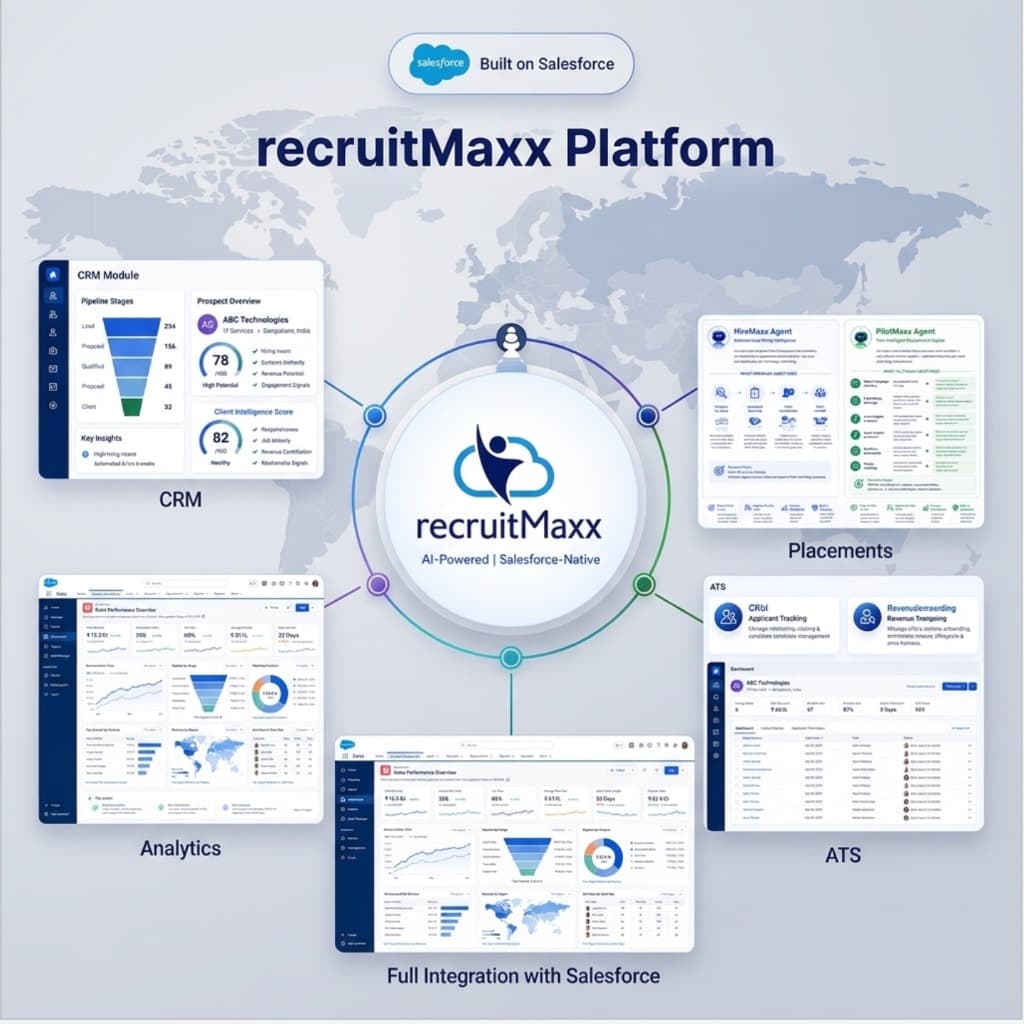
The only permanent solution to the Franken-stack problem is architectural consolidation. By moving your entire operation to a unified platform built natively on Salesforce, you eliminate data silos instantly. Your CRM, ATS, and back-office operations exist in a single, hyper-secure environment.
Frequently Asked Questions (FAQs)
1. What is context switching?
It's the mental friction and time lost when an employee constantly moves between different apps (e.g., email, ATS, billing software) to complete a single task.
2. How does a unified platform improve margins?
By saving 1.5 hours per recruiter per day, you unlock thousands of hours annually. That time is immediately redirected to sourcing and closing deals, driving up revenue.
3. Why is API integration not enough?
APIs are fragile bridges between databases. They frequently break during updates, creating hidden data silos where one team sees outdated information.
Unify Your ATS, CRM & AI Sourcing on Salesforce
Stop paying for disconnected subscriptions and broken middleware. See how recruitMaxx saves recruitment agencies 15+ hours per consultant each week.