Why Recruitment Agencies Are Abandoning Disconnected Tech Stacks: The Hidden Cost of Middleware in 2026
Running a fast-growing recruitment agency with a fragmented tech stack is like driving a high-performance sports car with misaligned wheels. In 2026, the silent killer of agency profitability is not a lack of candidate resumes—it is the operational drag and financial leakage caused by disconnected tools and broken middleware.
Key Takeaways
- The Middleware Tax: Mid-sized staffing firms spend between $15,000 and $45,000 annually on API connectors (MuleSoft, Workato, Zapier) that frequently break during software updates.
- 1.5 Hours Lost Daily: Every recruiter loses roughly 90 minutes per day copy-pasting candidate records, client notes, and placement data between separate ATS, CRM, and billing systems.
- Placement Margin Erosion: Without real-time Gross Margin validation at the job order level, agencies leak 3% to 7% of potential profit on contractor rate concessions.
- The Native Alternative: Consolidating onto Salesforce recruitment software eliminates sync debt completely with a unified database.
The Top 3 Pain Points of Disconnected Recruitment Tech Stacks
Most recruitment agencies did not set out to build a fragmented tech stack. As they scaled, they added point solutions: a standalone CRM for business development, a legacy ATS for resume parsing, a third-party tool for candidate texting, and separate accounting software for contractor timesheets. While each tool may work well in isolation, connecting them creates compounding technical friction.
1. Data Sync Lag & Duplicate Candidate Ghost Records
When your Applicant Tracking System (ATS) and Recruitment CRM live in separate databases, data synchronization relies on API webhooks. A candidate updated by a recruiter on LinkedIn may not sync to the billing database for hours, leading to duplicate candidate entries, conflicting client ownership claims, and embarrassing double-submissions.
2. The Exponential Cost of Middleware Integration
Connecting standalone platforms like Bullhorn or Vincere to enterprise tools requires expensive middleware. When an API endpoint updates, webhooks fail silently, leaving recruitment directors with corrupted reporting and unplanned engineering repair bills.
3. Disconnected Back-Office Billing & Cash Flow Delays
The placement lifecycle does not end when a candidate signs an offer letter. In contract and temporary staffing, timesheets must be validated, margins calculated, and invoices dispatched. When finance teams have to re-key placement data from an ATS into standalone accounting tools, invoice generation is delayed by up to 14 days, straining agency working capital.
Comparing Fragmented Tech Stacks vs. 100% Salesforce-Native Architecture
| Operational Dimension | Disconnected Point Solutions | recruitMaxx (100% Salesforce Native) |
|---|---|---|
| Database Architecture | Multiple siloed databases linked by webhooks | Single Force.com database for CRM, ATS & Billing |
| Middleware & Sync Breaks | Frequent sync lag ($15k–$40k/yr connector maintenance) | Zero middleware needed — 0% sync breakage |
| AI Agent Capabilities | Generic external chatbots with no real-time CRM access | HireMaxx & PilotMaxx on Agentforce |
| Timesheet to Invoice Speed | 7–14 days (manual CSV exports & audits) | Instant 1-click automated invoicing (Pay-Bill Module) |
| Enterprise Security | Fragmented across various point vendors | Native Salesforce Shield, SOC-2 & HIPAA compliance |
How recruitMaxx Eliminates Tech Stack Fragmentation
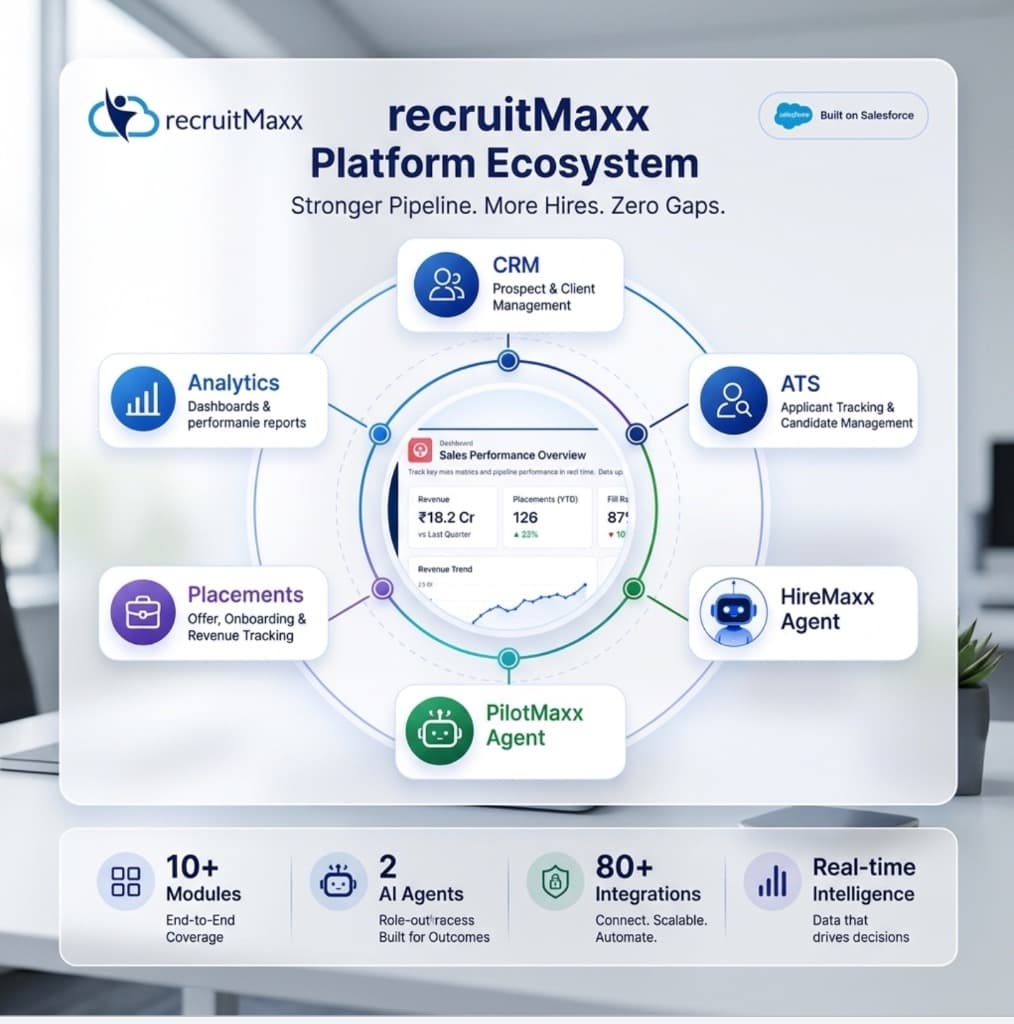
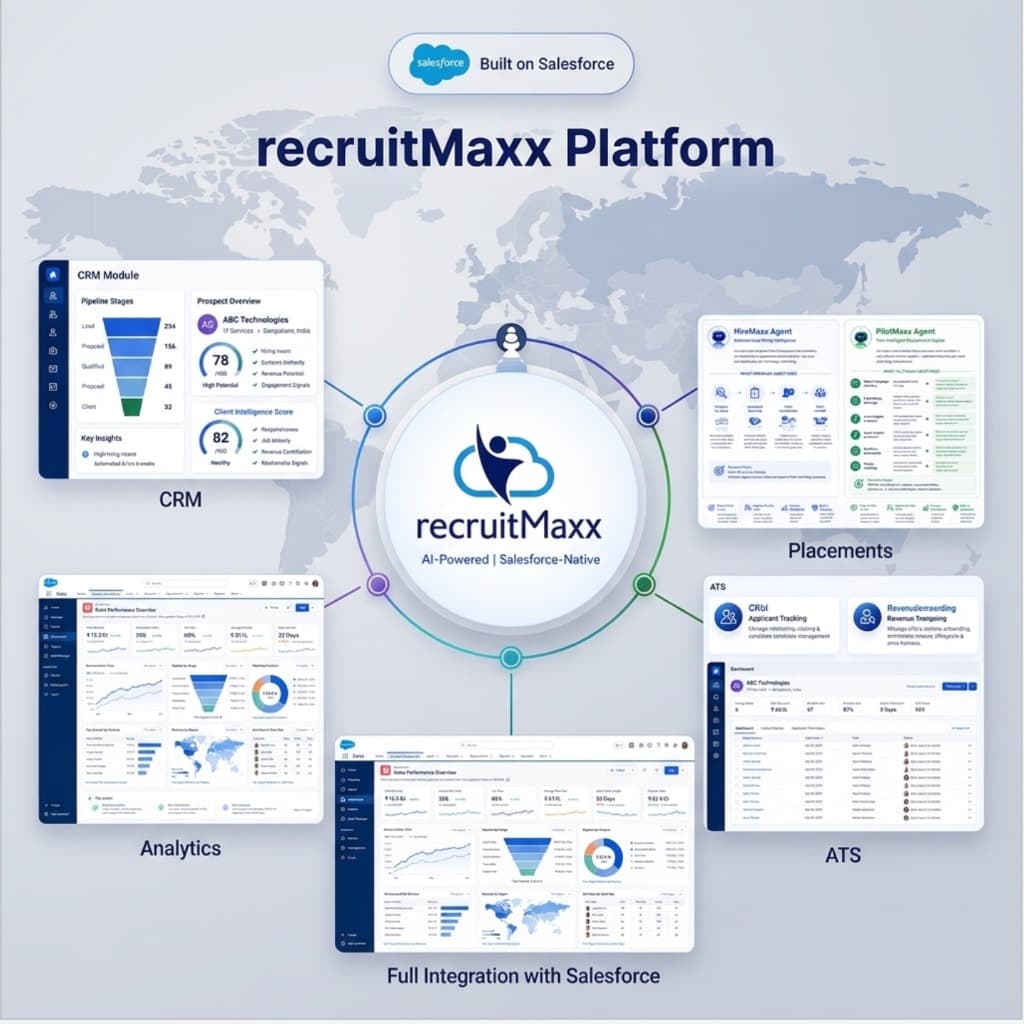
recruitMaxx replaces up to five separate SaaS subscriptions with a single, comprehensive recruitment operating system built natively on Salesforce:
- Unified Data Model: Candidate profiles, client mandates, placement milestones, and invoice lines share the exact same database records.
- Automated Gross Margin Protection: Prevents recruiters from submitting candidates below required gross margin thresholds before client submission.
- Autonomous Sourcing Agents: HireMaxx actively sources and pre-qualifies candidates 24/7 directly within your Salesforce database.
- Back-Office Accounting Sync: Automatically generates compliant PDF invoices and syncs them directly with QuickBooks, Xero, and Sage.
Calculate the Real Cost of Tech Fragmentation on Your Agency
How much is your current disconnected software stack actually costing you in lost consultant hours and middleware maintenance? Use our interactive Recruitment ROI Calculator to model your savings, or schedule a 20-minute live demonstration to see how high-growth agencies consolidate on recruitMaxx.
Frequently Asked Questions (FAQs)
What does "100% Salesforce-Native" mean for a recruitment agency?
It means the entire ATS, CRM, candidate database, and timesheet billing engine are built directly on custom Force.com objects. Your data never leaves your Salesforce environment, eliminating all external API connectors and security vulnerabilities.
How hard is it to migrate data from Bullhorn or Vincere to recruitMaxx?
recruitMaxx provides full white-glove data migration. Our engineering team extracts, cleans, deduplicates, and maps your candidate history, client notes, and placement records directly into Salesforce without business interruption.
Can recruitMaxx handle contract, temporary, and executive search desks simultaneously?
Yes. recruitMaxx features dedicated workflow modules for contract staffing, executive search, and healthcare staffing, all within one platform.
Unify Your ATS, CRM & AI Sourcing on Salesforce
Stop paying for disconnected subscriptions and broken middleware. See how recruitMaxx saves recruitment agencies 15+ hours per consultant each week.